
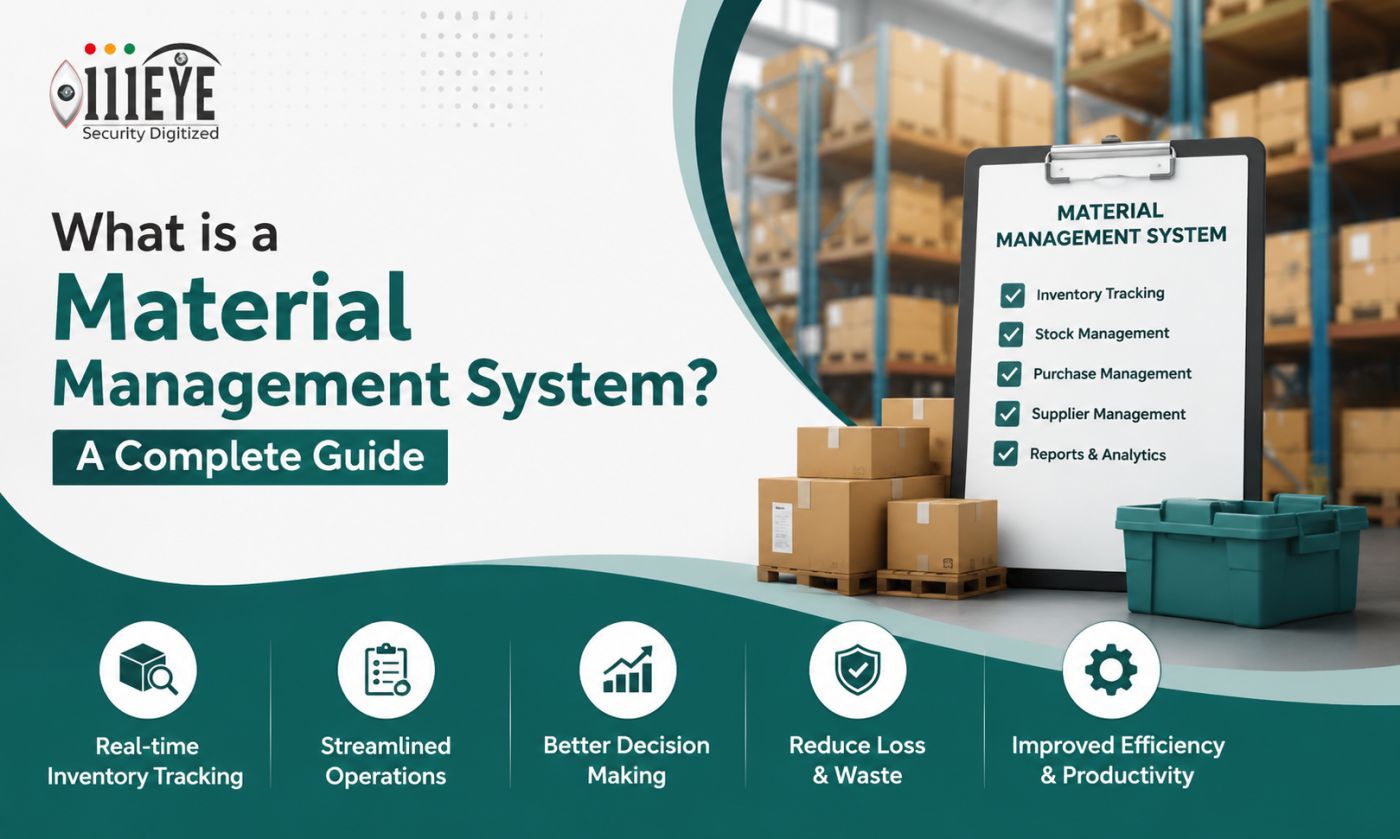
What is a Material Management System? A Complete Guide
Every organisation that handles physical goods — raw materials, tools, spare parts, files, equipment, or finished products — faces the same operational question: where is it, who has it, and can we prove it? Answering that question with a paper register or a scattered set of Excel sheets becomes unreliable the moment an organisation grows past a handful of locations or vendors. This is the gap that a material management system is built to close.
This guide covers what a Material Management system is, how it works, the features that separate a basic register from a modern platform, and the industries where it has become essential rather than optional.
What is a Material Management System?
A material management system is a software platform used to plan, track, and control the movement of physical materials as they enter, move through, and leave an organisation's premises. It replaces manual gate registers and paper-based material slips with a digital record of every inward and outward movement — capturing what the material is, who brought it in or took it out, which vendor or department it belongs to, and when it happened.
At its core, the system answers four questions for every item that crosses a gate, store, or department boundary: what moved, who moved it, where it came from or went to, and when it happened. Everything else — dashboards, approvals, alerts, and reports — is built on top of that basic movement record.
Also, Read more here - Why your business needs a smart visitor management system
Why Material Management Matters
Accountability: A digital trail removes ambiguity about who received, approved, or dispatched a given item, which matters during audits, disputes, or investigations into loss.
Security: Unauthorised removal of materials, tools, or equipment is a common source of shrinkage in factories, warehouses, and even corporate offices. A system that logs every movement makes unauthorised removal far harder to hide.
Compliance: Regulated industries — pharmaceuticals, healthcare, government contracting — often require an auditable record of material movement as part of statutory or client-mandated compliance.
Operational visibility: Facility and procurement teams can see, in real time, what has arrived, what is pending, and what has been dispatched, instead of reconstructing this after the fact from paper slips.
Core Components of a Material Management System
1. Material Requisition and Planning
Departments raise a request for materials they need, specifying quantity, purpose, and urgency. This creates a digital record before the material even arrives, which the system can later match against what is actually received.
2. Inward Material / Gate Entry
When a vendor, courier, or contractor brings material onto the premises, the security desk or gate logs the entry — material type, quantity, vendor name, associated purchase order or challan, and vehicle details if applicable. Many systems generate a digital gate pass at this stage.
3. Verification and Storekeeping
The store or receiving department verifies the material against the purchase order, records any discrepancy, and updates inventory records. This step is where most manual systems break down, because verification and paperwork happen in two different places that rarely reconcile automatically.
4. Storage and Internal Movement Tracking
Once received, materials are stored and tracked as they move between departments, floors, or project sites — for example, raw material moving from a central store to a production line.
5. Material Issuance
When a department or contractor draws material for use, the system logs who took it, how much, and for what purpose, tying the issuance back to the original requisition.
6. Outward Material / Exit Gate Pass
Materials leaving the premises — whether returned to a vendor, sent for repair, or dispatched to a client — are logged with an outward gate pass, closing the loop on that item's movement history.
7. Reporting and Audit Trail
Every step above generates a timestamped record. Reports can be pulled by vendor, department, date range, or material type, giving admins and auditors a complete movement history without manually cross-referencing paper registers.
Manual vs Digital Material Management
Paper registers: Prone to illegible handwriting, missing entries, and no way to search or cross-reference records quickly. A discrepancy investigation can take days.
Spreadsheets: An improvement, but they depend on manual data entry at each stage, offer no real-time visibility across gates or sites, and are easy to edit after the fact without a clear audit trail.
Digital material management systems: Capture data once, at the point of entry or exit, and make it instantly searchable across every gate, store, and site — with a tamper-evident audit trail that manual systems cannot offer.
Key Features to Look For
-
OTP or biometric verification for vendors, drivers, and contractors bringing material in or out
-
Digital gate pass generation with barcode or QR code for fast entry and exit
- Real-time dashboards showing inward, outward, and pending material across all locations
- Role-based access so only authorised staff can approve or edit material records
- Integration with purchase orders so received quantities can be matched automatically
- Multi-site support for organisations managing several factories, offices, or warehouses
- Exportable, audit-ready reports for compliance and internal review
Organisations evaluating vendors for this capability typically look for a purpose-build material management system software rather than adapting a generic inventory tool, since gate-level security, vendor verification, and compliance reporting are requirements a general inventory system usually isn’t designed around.
Benefits of Implementing a Material Management System
Reduced pilferage and shrinkage: A logged, photographed, and timestamped record at every gate discourages unauthorised removal and makes it traceable when it does happen.
Faster audits: Auditors can pull a complete movement history for any material or vendor in minutes instead of days of manual reconciliation.
Better vendor accountability: Delivery delays, short quantities, and quality issues become visible and attributable to a specific vendor and date.
Lower administrative overhead: Security and store staff spend less time on paperwork and more time on verification and safety.
Data for decision-making: Trends in material consumption, vendor reliability, and department usage become visible over time, supporting better procurement planning.
Real-World Examples
Manufacturing plant: A factory receives raw material from twelve vendors daily. Security logs each delivery against its purchase order at the gate; the store team verifies quantity on arrival; production draws material against a requisition. If a discrepancy shows up between what was ordered and what reached the production line, the system pinpoints exactly which stage it happened at.
Construction site: Cement, steel, and equipment arrive from multiple suppliers over the course of a project. A digital gate pass records each delivery, and the site engineer can generate a consumption report against the project's material budget at any point.
Corporate office: IT assets, courier packages, and vendor equipment move in and out of a corporate campus daily. A material management system logs each item against the employee or department responsible, closing a common gap in office security.
Hospital: Medical equipment, pharmaceutical stock, and biomedical waste containers move between departments and external vendors. A logged, time-stamped record supports both patient safety protocols and regulatory audits.
Industries That Rely on Material Management Systems
-
Manufacturing and factories — Raw material inward, work-in-progress movement, and finished goods dispatch
-
Construction — Tracking material delivered against project budgets across multiple sites
- Healthcare — Equipment, pharmaceutical stock, and biomedical waste movement with compliance requirements
- Warehousing and logistics — High-volume inward and outward material with multiple vendors and carriers
- Corporate offices and IT parks — Asset movement, courier tracking, and vendor equipment logging
- Education institutions — Lab equipment, furniture, and campus asset tracking across departments
- Government and PSU facilities — Audit-mandated material records for public procurement
- Hospitality — Inventory movement across kitchens, housekeeping, and maintenance stores
Common Challenges Without a Material Management System
-
No single source of truth for what has entered or left the premises on a given day
-
Discrepancies between purchase orders and actual receipts going unnoticed until stock counts
- Slow, manual audit preparation that pulls staff away from daily operations
- Difficulty proving compliance to clients, regulators, or internal auditors
- Higher risk of unauthorised material or asset removal going undetected
How to Choose the Right Material Management System
The right platform depends on the number of sites, the volume of daily material movement, and how tightly material tracking needs to integrate with security and visitor management. For organisations already digitising other parts of premises security — visitor entry, employee gate pass, file movement — it's worth evaluating a material management system software that sits on the same platform as those other modules, rather than a standalone tool that creates yet another disconnected record to reconcile.
Conclusion
Material management stops being a paperwork exercise and becomes a real operational safeguard once it is digitised — giving organisations accountability, security, and audit-readiness that manual registers and spreadsheets cannot match. Whether the setting is a factory floor, a construction site, a hospital, or a corporate campus, the underlying need is the same: know what moved, who moved it, and when, without having to reconstruct it after the fact.